Infrastructure for the unbanked
Infrastructure for the Unbanked at Scale.
Closing the financial gap through institutional-grade digital currency systems. A stable, non-speculative middle path between volatile markets and legacy bottlenecks.
- Built in Australia
- MVP deploying in Cameroon
- Central-bank sandbox approved
- PayAll Pty Ltd
- Sefilata Pty Ltd
- RisingHF
- Microchip
The problem
Mobile money proved the demand. It also built the silos.
Every mobile-money platform runs its own closed ledger. They can't talk to each other, they charge merchants to accept payment, and they stop working the moment coverage does. Crypto solved the interoperability and failed everything else.
- 1.4Badults with no bank account190 million in India alone.
- 1–3%merchant fees on mobile moneyEnough to exclude a trader working on thin margins.
- 3–7%to send money across a borderAnd it takes one to three days to arrive.
- No IDmeans no account, anywhereMillions cannot be onboarded even where service exists.
Three ways to pay
Three doors. One ledger.
A rural merchant on a radio terminal and an urban shopper on a phone transact with each other natively — no bridge, no correspondent account, no bilateral agreement. Every path settles on the same permissioned ledger.
The flagship
Pay with nothing but your hand.
It works when the phone is dead, the wallet is forgotten, and the user cannot read.
- 2–4s
- to authenticate
- 3–5 cm
- contactless
- <0.01%
- false rejection rate
- <0.0001%
- false acceptance rate
It reads what's under the skin
Near-infrared light images the vein pattern beneath the surface of the palm. It can't be photographed covertly or lifted off a glass the way a fingerprint can.
Liveness is inherent, not added
The pattern is only visible while blood is flowing through it. A printed image, a silicone mould, or a detached hand simply fails — there is nothing to detect.
The image is destroyed immediately
Only an irreversible mathematical template survives the scan. It is encrypted, held in a secure vault inside the country, never stored on the scanner, and can't be correlated between devices.
Bigger amounts ask for more
Small payments are palm-only. Larger ones add a one-time code to the registered phone, and the largest add a compliance hold before they settle.
Shipped and live
What the app actually does.
Not a roadmap. This is the build that is in people's hands today in Cameroon, in English and French.
- 01
Scan to pay
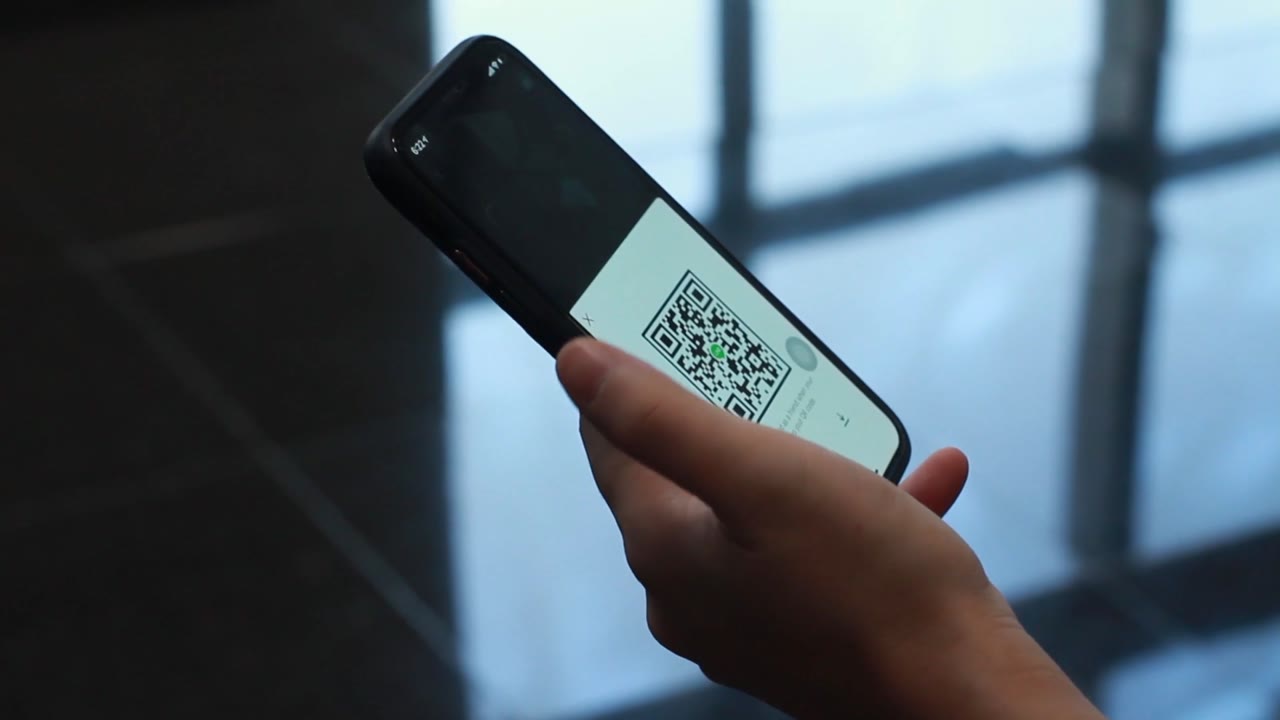
Scan the merchant's code, confirm with a fingerprint or your face, done in two to five seconds.
- 02
Send
One flow for everyone. Enter a number and the app works out whether they're on a phone or behind a merchant terminal.
- 03
Collect
Group payments with a live tracker — set a total, share a link, watch “3 of 5 paid” update in real time, then close it when everyone has paid. Built for the way communities actually pool money: funerals, church collections, group contributions.
- 04
Payment codes
A single-use code that expires in 60 seconds and is scanned by the merchant, so the customer never exposes their account.
- 05
Offline mode
Keep transacting with no signal — up to 50 transactions and $500, valid for 72 hours, syncing when you reconnect.
- 06
Every fee, in the open
Every transaction shows the fee, the total, the balance before and after, and which network path it travelled.
- Insights and spending analytics
- Searchable history
- In-app identity verification
- Session and device controls
- Airtime and bill payment
- Savings goals
- Push and SMS notifications
- English and French, in full
Where there is no internet
Payments that don't need a network to exist.
Most rural merchants aren't underserved because nobody built an app for them. They're underserved because there is no signal. The PayAll terminal pays over long-range radio instead of mobile data.
- 10–15 km of range from a single network gateway
- No mobile data required — the entire point
- Queues transactions offline and replays them when the network returns
- About seven days of battery, with a solar accessory for off-grid merchants
- Takes payment, displays a code to be paid, checks balance, runs agent cash in and out
- Opening the case destroys the keys inside it
- Firmware updates arrive over the radio network — no site visit
Field test · rural Cameroon · May 2026
- 97.3%
- transaction success
- 8.2s
- average latency
- 99.1%
- device uptime
- 0
- queue overflows
One firmware update was delivered to the fleet over the radio network in four minutes.
Two minutes of training was enough for every merchant, with no literacy barrier. Satisfaction came back at 4.2 out of 5.
Reaching people the rails cannot
Four ways in, for people the banking system has no way to serve.
Financial inclusion isn't a slogan here, it's a set of specific mechanisms — and the lowest tier pays nothing at all, funded by cross-subsidy from larger accounts.
No ID
Tier 0 onboarding
An agent verifies you in person and opens the account — no document required, for the large population that has none.
No bank
Agent cash in and out
Local agents move between cash and digital, under float limits, velocity monitoring, dual-signed transactions and daily reconciliation.
No smartphone
Basic feature phone
A USSD interface works on any GSM handset — no app, no data connection, no touchscreen.
No device
Your palm
Nothing to own, nothing to carry, nothing to lose. Enrolment is one in-person visit and it works everywhere the scanner does.
What it costs
0%
at the inclusion tier
Funded by cross-subsidy from larger accounts
0.1–0.3%
for ordinary accounts
Mobile money charges 1–3%. Card processors take 2.9% + $0.30.
0.8%
across a border, in 5–10 seconds
Existing rails charge 3–7% and take one to three days.
Fees are capped at the bottom by design: merchants and larger accounts fund zero-fee access for the inclusion tier, so cost never becomes the reason someone stays outside the system.
PayAll Stable Coins
PSC is the unit that moves across the ledger.
PayAll Stable Coins — PSC — are digital representations of real currency held in regulated bank accounts. Not a cryptocurrency, and not an investment product.
13 currencies — 6 available today, 7 planned across three years.
How PSC works- Backed one-for-one
- Every PSC in circulation is matched by real currency in a regulated custodial account — 100% collateral, audited independently every month.
- Non-speculative by design
- It is pegged, earns no yield, and does not appreciate. There is nothing to trade and nothing to speculate on.
- Network-internal only
- PSC cannot be sent to an exchange or a DeFi protocol. It exists inside PayAll and nowhere else.
- Always redeemable
- Convert back to cash at any time, through a registered agent or the custodian bank.
PSC are not investment products and are not offered as securities.
Running today
The compliance platform is a product, not a promise.
Everything on this page is live software that PayAll operates now — the console a compliance officer opens in the morning, not an architecture diagram of one.
AI pre-screens every identity document. A human compliance officer makes every decision.
Anti-money-laundering monitoring
Rules-based alerting with risk scoring, an investigation workflow and case management.
Dual approval on sensitive actions
Freezing an account takes a second administrator, and the approver can never be the person who requested it. Enforced in the database, not just the interface.
Role-based staff access
Five roles from support up to super-administrator, so operational staff only ever see what their job requires.
Fraud operations
Device-aware velocity rules, first-time-payee safeguards and an account-freeze workflow wired into every path money can move.
Alongside it: device onboarding built for 1,000-unit batches, full lifecycle tracking from provisioned through decommissioned, and live network operations across the deployed fleet — real-time status, remote configuration and firmware distribution.
Compliance in detailProof
The first production deployment is under way.
A field test in rural Cameroon in May 2026 beat every target it set. What follows is the first deployment at production scale.
- 1,000
- terminals deployingfirst production scale
- 5
- regions coveredCentre to Southwest
- 25
- network gatewaysthree overlapping per area
- 50
- edge unitsaggregation and offline queuing
Deployment runs in three waves — 500 terminals across Centre and Littoral, then 300 across West and Northwest, then 200 in the Southwest, including rural agricultural areas.
Regulatory position
- Central-bank regulatory sandbox approved, Q2 2026
- Full operating licence under review, expected Q3 2026
- Data localization agreement signed
- Custodian bank partnership signed
- Operational risk insurance secured
- India, Indonesia, Philippines, Brazil, Mexico, Kenya — preliminary discussions
A sandbox approval is not an operating licence, and this site will not call it one.
Honesty is part of the product
What PayAll is not.
- Not a permissionless blockchainNo public validator access — licensed institutions only.
- Not a cryptocurrency investment vehicleNo speculative token. It is pegged, pays no yield, and is never traded.
- Not censorship-resistantTransactions can be frozen per court order, and that is deliberate.
- Not anonymousEvery address is linked to a verified identity.
- Not a competitor to central banksDesigned to complement them, including their own digital currencies.
Where to go next
Start wherever you came from.
Or just write to us. Every message reaches a person who works on this.
info@payalldigital.com